
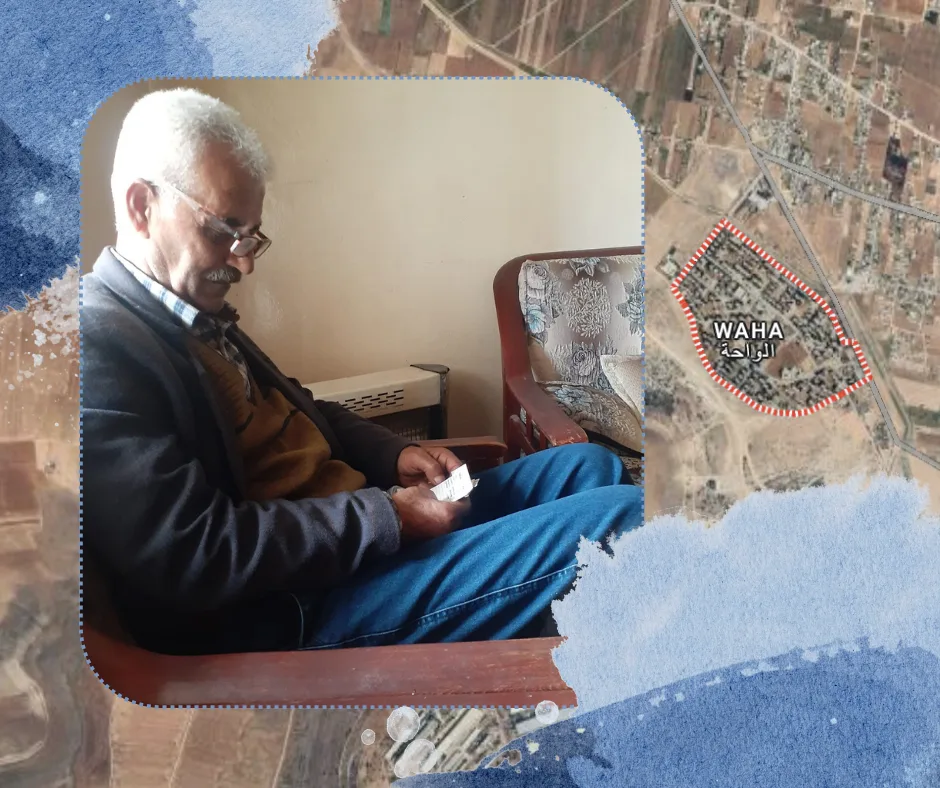
He was not armed. He was not a soldier. He was neither a supporter of the regime nor a supporter of the Islamists. All he wanted was a quiet life in his apartment in the “Waha Housing” neighborhood after he retired due to a stroke and his Afrini family scattered to the ends of the earth.
It had not always been like this. He was once a passionate fighter who dreamed of a different Syria — one that was open to all. This dream cost him years in Saydnaya prison 37 years ago, at a time when “Abu Muhammad al-Julani” was still living in the Damascus district of “al-Mazza Villas al-Sharqiya” and was being trained as a vanguard in the Assad’s “Baath party Vanguard”.
When he woke up that morning, he was the same man he had always been. But fate had brought him face to face with Julani’s men.
Time: Morning of December 1, 2024.
Place: The “Waha” Housing, 1.5 kilometers from the military defense factories in al-Safira, south of Aleppo.
On November 29and 30, 2024, the “revolutionaries” or the “Turkish proxies” (depending on where you stand) took control of Aleppo. The city’s defenders — those who were supposed to protect it — had collapsed in just two days. Some fled towards the Sheikh Maqsoud neighborhood in northern Aleppo, others fled south towards al-Safira.
These “revolutionaries” or “proxies” realized that their long-prepared campaign of “deterring aggression” was much easier than expected. So they decided to extend the pursuit of the fugitives towards al-Safira, first to capture the defenses there and then to advance further towards Hama in order to take control of as much territory as possible. They found the way clear after the “SDF” fighters withdrew from the towns of Tal Aran and Tal Hasel, which lie between Aleppo and al-Safira, on the evening of November 30, 2024, in order to support the districts of al-Shahbaa and Sheikh Maqsoud.
Suddenly Abdu found himself in front of Julani’s men. The “Waha” neighborhood was almost empty, its residents having fled in anticipation of the attack. Abdu had evidently not fled like the others. He had no reason to be afraid. If the new arrivals were “revolutionaries” against Assad, he was four decades ahead of them. If they were Islamists, his name – “Abdu Abdel-Mannan Abdullah” – would surely work in his favor. And if they were Islamists against Assad, what did they have to do with an old man whose hair and mustache had turned white and who could barely stand on his own feet? A stroke, if it doesn’t kill you, leaves you only a ghost of yourself.
But in civil wars fought by sects and gangs, people cease to be people and values crumble. Even the bonds of a single family become weaker than the bonds of party affiliation; party loyalists rush into the most extreme acts for the flimsiest of reasons. They do not care about laws. All they want is to seize power by overthrowing the existing regime. They trust each other not because of religious brotherhood or social ties, but because they are partners in crime. This is what the ancient Greek historian Thucydides wrote 2,455 years ago when he described the civil war in Corcyra during the Peloponnesian War, as if he were a contemporary witness of our time.
Abdu probably did not know enough about the character of Julani. His illness had not given him the opportunity to do so. Had he known, he might have calculated differently.
Julani is known for his many transformations and twisted strategies. Once he was loyal to Abu Bakr al-Baghdadi, then he turned against him. He joined al-Qaeda, then broke away from Ayman al-Zawahiri again and presented himself as a “national” leader who wants to build a state. He has always adapted to changing political and martial conditions, reshaping “HTS” to appear as a nationalist movement rather than a movement focused on global jihad. He has put the emphasis on local administration and tried to win the trust of nations that still view him with suspicion.
In the last four years, he has succeeded in reshaping his image as a man capable of building a state. He tested his policies by building institutions in north-western Syria — numerous institutions based on self-reliance and incorporating various local elements. These proved to be effective, especially in comparison to the “Autonomous Administration” in north-eastern Syria, which was unable to achieve the same results despite having greater financial and military capacities. Julani pretended to stay put, while the leaders of the “Autonomous Administration” acted like temporary administrators of “Rojava”,” representing only a transitional phase on the way to their larger goal in Turkish Kurdistan. Even when Julani arrived in Aleppo amid the chaos of the fighting, he was better organized. He immediately opened channels through which residents could lodge urgent complaints, began paving and lighting the streets, restored electricity to homes, sent fighters to protect banks from looting, reassured the Christian community and provided safe passage for Kurdish fighters to leave Aleppo with their weapons. He is acting with clear pragmatism in order to gain the necessary legitimacy. He had been preparing for this moment since at least April last year, when he announced to his fighters that they would celebrate the next Eid al-Fitr in Aleppo — and now he has delivered four months ahead of schedule.
But in the long run, Julani cannot completely shed his old skin. The administration of Aleppo is different from the administration of a conservative rural region like Idlib. He will have to adapt ideologically to inhabitants who are much more diverse, both demographically and culturally. His fighters failed their first test when they shot their bullets into the body of Abdu Abdel-Mannan Abdullah for no reason and then sent a photo of his corpse to his son in the Netherlands. They knew he was different from them —they knew he was from Afrin, which they themselves had occupied, and they were trying to cover one crime with another.
Julani’s self-invention undoubtedly includes a turn to a kind of technocratic Salafism and a PR maneuver to convince outsiders that he is no longer a threat to anyone except President Bashar al-Assad and those trying to save him. Even some of his secular supporters have been fooled. Julani followed developments in Afghanistan closely and wanted “Hay’at Tahrir al-Sham” to appear softer and more tolerant than the Taliban in order to persuade states to treat him as a de facto authority — perhaps even recognize him. Why not? If the Taliban can travel to Moscow and sit across from President Vladimir Putin, even though Russia classifies them as a terrorist organization, why shouldn’t Julani be able to realize his own dream one day and travel to Russia as a recognized authority? He sees himself not only as something better than the jihadists who roam around in search of innocent blood, but as someone who is actively at war with them.
All these images must have gone through Putin’s mind when he received Assad in the Kremlin on November 28, 2024. The news of the imminent fall of Aleppo reached him instead of the expected news of the fall of Kyiv. He must have watched his guest closely as he saw Assad lose in a matter of hours what Russia had spent years building up. He was certainly not pleased.
After all, in a few months Putin will enter the fourth year of the war in Ukraine — a war that should have ended within two weeks. Now he is relying on foreign fighters to make up for the staggering military losses estimated at over 700,000 Russian soldiers. Since February 2022, when the invasion of Ukraine began, Russia has reduced its presence in Syria, scrapping the role of the mercenary group Wagner after its mutiny a year ago and removing some of its most advanced air defense systems. All this is happening as a changing of the guard takes place in Washington — from the administration of outgoing President Joe Biden to the second term of Donald Trump.
No doubt Putin is now weighing up the situation as he sees the almost complete collapse of the military leadership in Syria and the collapse of their control and morale. They can’t even regroup or launch a counter-offensive. He turns his gaze to President Recep Tayyip Erdoğan, who seized the opportunity and gave the green light for the Hay’at Tahrir al-Sham operation, improving his own position at the next negotiating table— – probably about the US withdrawal from northeastern Syria — after his attempts to negotiate reconciliation and normalization with Damascus failed.
Putin also has a grudge against Assad. Despite all Russian efforts, Assad still puts Iran at the top of his priorities as Plan A and treats Russia as Plan B. Putin has grown weary of this. One explanation for Russia’s slow reaction could be that Erdoğan informed Putin in advance about the Hay’at Tahrir al-Sham operation and promised it would be limited — a means to force Assad to take Turkey seriously and make concessions and reforms. Yes, Putin and Erdoğan are formidable rivals, but their relationship is based on the mutual disdain of the United States and the West and a mutual respect that always grows when one outwits the other. With his swift advance, Julani has given Putin a surprise and Erdoğan a priceless gift. It seems that both men now want to bring the troublesome leader in Damascus to his knees, despite their differences, which have been carried out with fire and steel.
That is not all. Turkey has taken over the fragmented north-western region of Syria, reassembled it and shaped it as it sees fit. The entire economic infrastructure, healthcare, education and, —most importantly, the security services have been built with Turkish support and are administered under its strong influence.
Assad has yet to recognize the full extent of Turkish control over what was once his country and his people. He has waged a bloody civil war to retain full control of a country he believes he inherited from his father. Power-sharing was never on his agenda.
But Erdoğan has no intention of handing back to Assad everything he has built up over the years. Therefore, the romantic notion of Syrians who support Julani’s operation that Turkey could make a deal and return everything in the name of international sovereignty is ridiculous. Turkey has always regarded Syria as “Sham Sharif”,” the noble Levant: once the capital of the Umayyads and a gathering point for Muslims on their pilgrimage to Mecca. It “saved” Damascus from itself when the Muslim inhabitants threw their city into hellish chaos after the “Tanzimat” reforms of the Ottoman period, attacking and burning down Christian neighborhoods in 1860 and killing anyone they could get their hands on. At that time, the Ottoman state put all its weight behind restoring order and ignored the uprisings elsewhere. It sent the foreign minister Fuad Pasha to Damascus for three months to punish the Sunni rebels, execute and shoot their leaders and devise a plan to rebuild the Christian neighborhoods by imposing a tax on the Muslims. The Ottomans then proclaimed the province of Sham with Damascus as its capital and rejected Beirut’s strong bid for capital status.
Turkey is polite in its official statements, but it does not respect Syrian sovereignty any more than the Russians respect Ukrainian sovereignty. The romantic ideas cherished by the Syrians will never be realized. Erdoğan will not give up any territory. He always keeps what he gains, consolidates his power, waits for the right moment and then expands further.
He knows that Turkey is the largest power bordering Syria and is more involved in this conflict militarily, economically and demographically than any other actor. He also knows that with a little patience and gradual progress, he will eventually achieve what he wants. If Julani does not switch allegiances again, as he usually does, the current alignment fully serves Erdoğan’s interests and plays into the Sultan’s hand — a Sultan who is pushing back all other actors in Syria.
When Abdu Abdel-Mannan Abdullah woke up in his apartment in the Waha settlement of al-Safira on December 1, 2024, he had no idea of all these entanglements. He did not even want to know. Perhaps the trees he saw through his west-facing window reminded him of the olive groves in his hometown of Afrin. Perhaps he remembered being born, growing up, studying, being imprisoned, being released, working, marrying and fathering children who in turn grew up and were repressed — by the very same factions driven by the same ideology, the same thirst for revenge. They killed their father in cold blood, in broad daylight, shouting “Allahu Akbar”.